INTRODUCTION:
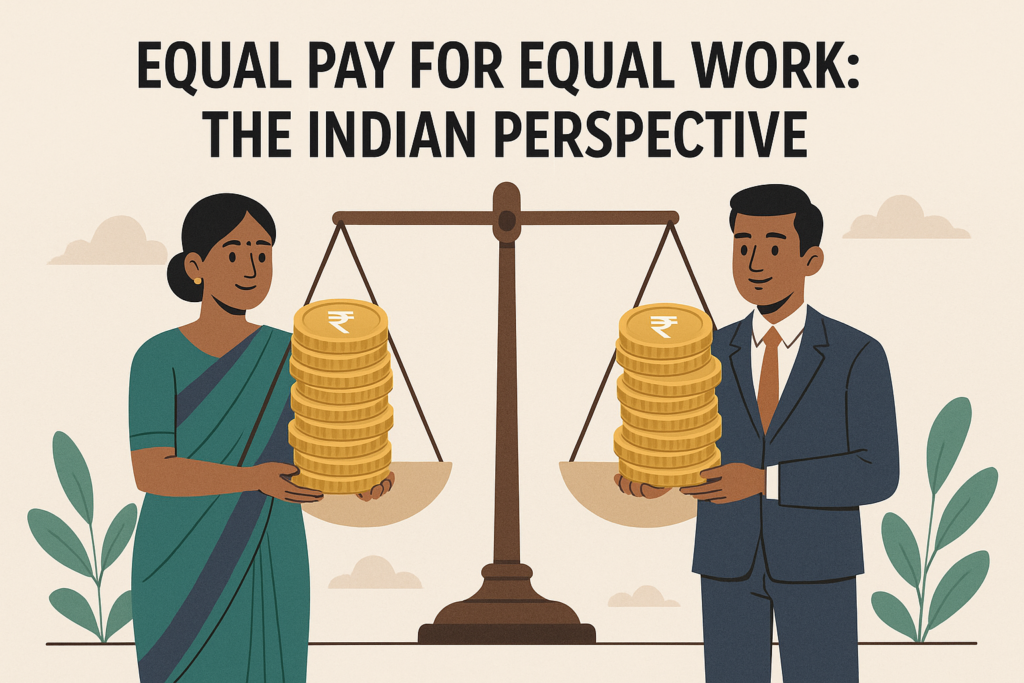
Equal pay for equal work has been a long-standing issue in India, with women, in particular, being paid less than their male counterparts for doing the same job. Although the country has made some progress in recent years, gender pay disparities continue to exist. Historically, women in India were relegated to the domestic sphere and were not encouraged to participate in the workforce. This patriarchal attitude meant that women were not allowed to pursue careers and, if they did, were paid much less than men. Discrimination against women was entrenched in society, and women were not given equal opportunities to succeed.
BACKGROUND:
Equal pay for equal work has been a subject of discussion and debate for decades in India. While the issue has often been framed in terms of gender pay gap, it is not limited to that. The concept of equal pay for equal work encompasses a broader range of factors that affect workers in various fields, regardless of their gender. In the past, the idea of equal pay for equal work was not given much importance in India. Many employers believed that they could pay workers whatever they felt was appropriate, and that workers did not have the power to demand more. This lack of concern for workers’ rights was evident in the poor wages and working conditions in various sectors of the economy. For instance, workers in the informal sector, such as those in agriculture, construction, and domestic work, were not entitled to any minimum wage or social security benefits.[1]
Over the years, the scenario has shown a steady amelioration. India’s Constitution enshrines the principle of equal remuneration for equal work, bolstered by statutes such as the Minimum Wages Act of 1948, which prescribes a statutory minimum wage across various sectors. The Equal Remuneration Act of 1976 explicitly outlaws wage discrimination predicated on gender, ensuring parity in pay for women performing analogous work to their male counterparts. Nevertheless, inequalities endure, particularly within the informal sector, where myriad laborers encounter precarious employment and irregular earnings. The COVID-19 pandemic exacerbated these challenges for gig workers. Despite existing legal safeguards, marginalized cohorts frequently experience discrimination. Initiatives such as the PM-SYM scheme and public sensitization campaigns strive to ameliorate these injustices.
ILO Equal Remuneration Convention, 1950:
The Convention concerning Equal Remuneration for Men and Women Workers for Work of Equal Value, or Equal Remuneration Convention is the 100th International Labour Organization Convention and the principal one aimed at equal remuneration for work of equal value for men and women.
Article 2 of this very statute is of high relevance to the topic I have in hand, it provides that:
“Each Member shall, by means appropriate to the methods in operation for determining rates of remuneration, promote and, in so far as is consistent with such methods, ensure the application to all workers of the principle of equal remuneration for men and women workers for work of equal value.”
This provision was the first of its kind which went onto mention the concept of equal pay for equal work, this was a watershed moment and India ratified this convention in the year 1958 on 25th September.
Constitutional backing and the correlated legal history:
Article 39 of Indian constitution provides Certain principles of policy to be followed by the State, A39(d) provides that “that there is equal pay for equal work for both men and women”, although the same has been mentioned as a DPSP and being not justiciable in a court of law, it does provide impetuous to the case and as had been intended by the constitutional makers that the DPSP’s shall operate as guiding lights for the lawmakers.
The year 1975 was celebrated as the International Women’s Year, to mark this occasion the then President of India promulgated an ordinance to provide for the right of equal remuneration, this was subsequently replaced by the Equal Remuneration Act of 1976.
Equal Remuneration Act, 1976 and the rights provided by it:
The Equal Remuneration Act, 1976 provides for two rights:
- Equal pay for equal work:
No employer shall pay to any worker remuneration at rates less favorable than those at which remuneration is paid by him to the workers of the opposite sex for performing the same work or work of the same nature. For complying with the law, no employer shall reduce wages of any worker.
- No discrimination in recruitment:
No employer shall, wrt recruitment, promotions, training or transfer regarding same work or work of a similar nature, discriminate against women.
Code on Wages:
The newly formulated Code on Wages has repealed the Payment of Wages Act, 1936, the Minimum Wages Act, 1948, the Payment of Bonus Act, 1965, and the Equal Remuneration Act, 1976. It is crucial that the objectives of these acts are upheld by the new code, which does provide for equal pay for equal work. Section 3 states:
- There shall be no gender-based wage discrimination within an establishment.
- Employers shall not:
- Reduce wages to comply with the non-discrimination clause.
- Discriminate based on sex in recruitment or employment conditions, except where legally prohibited for women.
What has been the position through various decided case laws?
The question whether Equal pay for equal work can be claimed as a matter of fundamental right was discussed at length in the case of State of Haryana and Anr. Vs. Haryana Civil Secretariat Personal Staff Association.[2] The Supreme Court observed that the High court compared employees having only the same designation under state and central secretariats, the Supreme Court placed reliance on the judgment in the case of Secretary, Finance Department v. West Bengal Registration Service Association and Ors.[3] The Supreme Court laid down the following factors for job evaluation:
- The work programme of his department
- The nature of contribution expected of him
- The extent of his responsibility and accountability of the discharge of his diverse duties and functions
- The extent and nature of freedoms/limitations available or imposed on him in the discharge of his duties
- The extent of powers vested in him
- The extent of his dependence on superiors for the exercise of his powers
- The need to co-ordinate with other departments, etc.
The Supreme Court subsequent to this, also laid down the factors for determining pay structure:
- Method of recruitment
- Level at which recruitment is made
- The hierarchy of service in a given cadre
- Minimum educational/technical qualifications required
- Avenues of promotion
- The nature of duties and responsibilities
- The horizontal and vertical relativities with similar jobs
- Public dealings
- Satisfaction level
- Employer’s capacity to pay
The Supreme Court observed that “It is to be kept in mind that the claim of equal pay or equal work is not a fundamental right vested in any employee though it is a constitutional goal to be achieved by the government. It was also observed by the Supreme Court that the high court has not even made any attempt to compare the nature of duties and responsibilities of the two sections of the employees, one in the State Secretariat and the other in Central Secretariat.”
This judgment of Supreme Court is widely criticized as being a bad judgment as the Supreme Court did not do anything substantial while it had all the power and opportunity to do so, The Apex Court simply laid down the factors for job evaluation and pay structure but it did not even apply these factors in the present case.
In State of MP vs R.D. Sharma,[4] SC, The Supreme Court has steadfastly affirmed that the formulation of pay scales is fundamentally an executive responsibility, not a judicial prerogative. Judicial bodies generally abstain from engaging in the intricate and laborious process of job evaluation, recognizing its extensive ramifications. This responsibility is more aptly managed by specialized entities such as Pay Commissions. Judicial intervention is reserved for instances where there is compelling evidence of a significant error in the establishment of a pay scale, warranting correction to rectify an injustice. The Court underscored that job evaluation falls outside the judiciary’s purview, cautioning that such intervention would amount to judicial overreach, thereby breaching the principle of separation of powers. Furthermore, the Court noted that the principle of equal pay for equal work, while a constitutional aspiration, does not constitute a fundamental right.
In summation, the doctrine of equal remuneration for equivalent work is not enshrined as a fundamental right but is emphasized as a constitutional objective for the government to actualize. Article 39(d) of the Indian Constitution elevates this tenet to a Directive Principle of State Policy (DPSP). Although positioned in Part IV and not under Fundamental Rights, the Supreme Court has consistently acknowledged that Fundamental Rights and DPSPs are interrelated and mutually reinforcing. Judicial bodies typically abstain from rendering definitive judgments on this principle, recognizing it as the purview of the executive and specialized agencies. Attaining wage parity is pivotal for India to dismantle gender-based barriers and to conform with global charters and declarations endorsing this precept.
[1] Preetha Soman, Vikram Shroff; India: Equal Pay For Equal Work In India: Wage Discrimination, Mondaq, (21 November 2016), https://www.mondaq.com/india/employee-benefits–compensation/546336/equal-pay-for-equal-work-in-india-wage-discrimination-between-permanent-and-temporary-employees-disallowed
[2] Appeal (civil) 3518 of 1997
[3] [1993] Supp 1 SCC 153
[4] Civil Appeal No. 474 of 2022